Prominent Democrat and Civil Liberties Champion Lays Out the Case Against Impeaching Trump
Read Transcript
- If you read the paper,
you find that a number of Democrats
are saying that they ought totry to impeach the President.
That if they take back congress,
can they do it and if not why not?
Well there's a book called
The Case Against Impeaching Trump
written by Professor Alan Dershowitz
and he says impeachment is a big mistake.
- [Crowd] Trump, traitor, treason
- [Reporter] President Trump had only
been office a few months
when the calls to impeach him began,
and they haven't stopped.
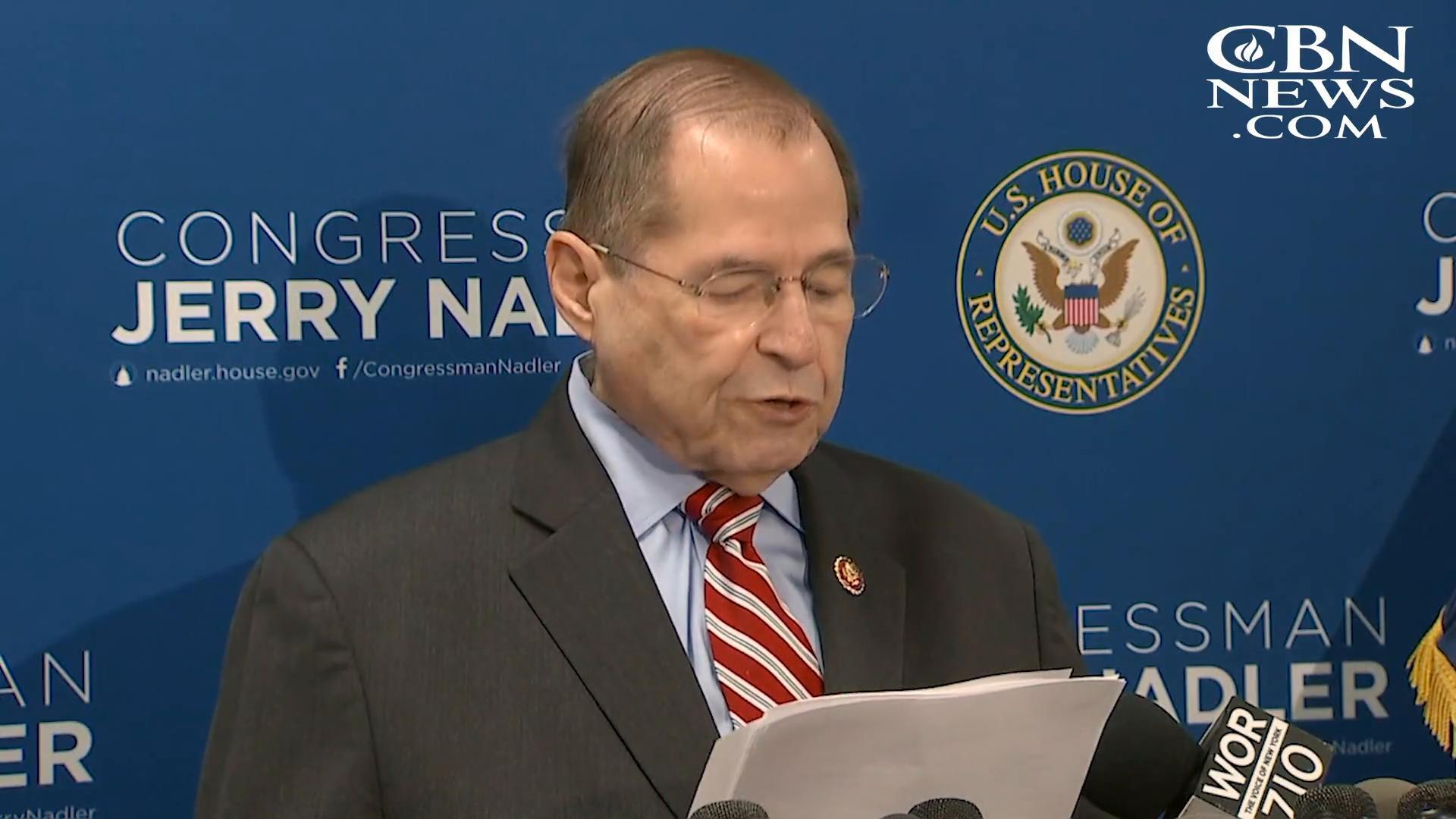
- We believe that President Trump has
violated the Constitution
and we've introduced fivearticles of impeachment.
- [Reporter] But as the drumbeat for impeachment grows,
one prominent defender ofcivil liberties in America
Alan Dershowitz says not so fast.
He says in the fervor toimpeach President Trump,
his political enemies have ignored
the text of the Constitution.
Dershowitz lays out the reasons
why those pushing forimpeachment should think again
in a new book The CaseAgainst Impeaching Trump.
- Well attorney andprofessor Alan Dershowitz
is joining us right now on Skype.
Professor it's delightfulto have you with us.
You've written a book
tell me what the Constitutionsays to start off
what grounds do you haveunder the Constitution
for an impeachment againsta sitting president?
- Well I think Pat both of us learned
at Yale Law School thatthe first place you look
when you're asked a questionabout the Constitution
is to the text of the Constitution.
And the text says that inorder to impeach a president
you have to convict him on atwo-thirds vote in the senate
of either treason or a bribery
or other high crimes and misdemeanors.
And the framers meant what they said.
They rejected a provision that said
you can impeach a presidentfor mal-administration
or being a bad president.
You need to show that hecommitted an actual crime.
And there's just no evidence at the moment
that President Trump hascommitted an actual crime.
Now some Republicans arepulling into the same trap
because they want toimpeach Rod Rosenstein
and Rod Rosenstein hasn'tcommitted any crime.
So I'd be against impeaching Rosenstain.
I'd be against impeachingour President Trump.
And if Hilary Clinton were president,
I'd be against impeaching her.
I just don't think you can impeach
based on disagreements and policies.
You have to prove theexistence of an actual crime.
- What is a high crime of misdemeanor?
Has that been defined carefullyby the legal scholars?
- I would say it's been defined carelessly
not carefully.
The framers had in mindsomething very interesting.
They didn't mean any ordinary crime.
I'll tell you a storyabout Alexander Hamilton.
It really explains thisbetter than anything else.
When Hamilton wasSecretary of the Treasury
a man and a woman decided to set him up,
a married couple.
And so they sent the womanto seduce him and she did.
And then the man demanded extortion
and he paid it in order tokeep it secret from his family.
But then the man accusedhim of using treasury funds
to pay the extortion and he denied that.
And he wrote an essay
posing tremendousembarrassment to his family
admitting the affair which was adultery
which was a serious crime
and admitting paying the extortion
but denying that he usedthe funds from the treasury
because he knew that using treasury funds
would be a high crime.
A crime involving governance
whereas simply committingadultery was a crime
but it was a low crime,
not a crime warranting impeachment.
And I think that's the difference
that Hamilton and others.
Hamilton afterward wrote thepart of the Federalist Papers
that dealt with impeachment
so I think he knew whathe was talking about.
- Will you point out that the
there's a rule that we have established
about coming against sitting officials
doing their Constitutionallyappointed offices.
Can you talk about that?
- Sure we can not eitherimpeach or prosecute a President
for acting under ArticleTwo of the Constitution.
Under Article Two he'sentitled to fire anybody
he wants that was heldby the Supreme Court.
He's entitled to pardon anybody he wants.
That's an absolute power.
He's entitled to tellprosecutors who to investigate
and who not to investigate.
It's not a good idea to do that
but Thomas Jefferson did that,
John Kennedy did that.
Many presidents have toldprosecutors who to prosecute
and who not to prosecute.
And you cannot be charged with anything
criminal or impeachable
when merely exercising your authority
under Article Two of the Constitution.
- Well what about thisthing about collusion?
Is there such a thingas a crime of collusion?
- You know if two businesspeople get together
and collude to violate the anti-trust law,
that's a crime.
That's the only crime of collusion
in the entire federal criminal code.
But if a candidate hasa meeting at his home
with his son or whoever,
in order to get dirt onan opposing candidate
that's not a crime.
That may be collusion.
I don't think you wouldeven use the word collusion
to define that kind of meeting
getting dirt on an opponent.
But even if there were collusionit wouldn't be a crime.
You'd need to show a specific violation
of federal election laws.
You'd need to show some kindof bribery or extortion,
some real crime.
But simply colluding with another country,
even a country we don't like
is not in violation of anything
in the federal criminal code.
- You were talking about yourpost to the special counsel.
And you've come up witha very unique concept
of how we should deal withthis Russian involvement.
What do you suggest we do?
- Well it wasn't all that unique.
We did it after 9/11.
We appointed a non-partisancommission of experts
to look at how to prevent a future 9/11.
That's what we should've done here.
We should've appointedJustice David Souter,
a former of the Supreme Court,
Justice O'Connor, other experts,
former heads of the FBI, the CIA
to look into the whole issue
of Russian involvement of our election.
Russia did try to intrude in our election
and they're gonna try to do it again
and that's a serious problem.
But you should have had acommission doing it in the open
with transparency.
Instead we have aspecial counsel operating
behind the closed doorsof a grand jury room
and we're not gonna learn very much.
And he only hears one side.
He only hears the prosecution side.
He doesn't hear the defense side
or President Trump's side.
So I think it was an ill advised method.
I was opposed to special counsel
when it was appointed toinvestigate White Water
and that turned into an investigation
of both Clinton's sexualactivities in the Oval Office.
So I've never thought specialcounsel is a good idea
and I don't think it's been a good idea
in this case as well.
- You have an interestingchapter in this book
about Whitey Bulger thathis involvement with the FBI
and Mueller was head of the Boston office.
Was that tainted?
What did they do wrong?
- Oh they did everything wrong.
It was the worst timein FBI modern history.
There was this guy Whitey Bulger who was
a real hit man murderer.
He had a brother who wasthe head of the Senate
in Massachusetts.
And in order to protect the Bulgers
who it turned out WhiteyBulger was an informer
with a guy named Rifleman Fleming,
they accused four peopleof committing murders
that were in fact committedby this Rifleman Fleming
who was an informer.
And for years they kept theseinnocent people in prison.
Two of them died in prison.
Two of them finally got out.
They brought a lawsuit.
They collected tens of millions of dollars
from the government for this cover up.
But you can't ever get your life back
if you've been sent to prison improperly.
And Mueller was the US Attorney in Boston,
he was the head of theJustice Department's
unit in Washington and the head of the FBI
while all of this was happening.
He was also head of the FBIwhen they were searching
for Whitey Bulger and theywere not searching very hard.
He was in plain viewliving in Santa Monica
and reportedly walking in the streets
and even there was one report
that he used to go to a Red Sox bar,
a bar in Santa Monicathat has Red Sox fans.
And he would sit in a special back room
and watch the game and people knew.
People knew.
There were shirts that were printed
saying I saw Whitey. I saw Whitey.
But the FBI, the greatFBI couldn't find him.
And a lot of people thinkthey weren't looking very hard
because they didn't want to find him
because he could have madethe FBI look very bad.
Look the FBI is a wonderfulinstitution with great people,
agents who put theirlives at risk every day,
men and women who we shouldbe so proud of the FBI
but there is some bad apples.
And the question is who are the bad apples
that allowed this terriblescandal to go ahead
both in Boston and inSanta Monica, California?
- Would you advise Trump tosit down and talk to 'em?
Or do you think the counselis correct in saying
don't do it under oathit'll get you for perjury?
- Uh oh, listen to your lawyer.
You know I said on television once,
I have four pieces ofadvice for the President.
Don't Tweet, don't pardon, don't fire,
and don't testify.
I think the last oneis the most important.
You know they're gonna askhim what his motive was
for firing Comey andhe's gonna give an answer
and it may be a truthful answer,
but somebody else willgive another answer.
Or he'll be asked whetherhe knew about the meeting
in the Trump Tower and he'salready said he didn't.
And you'd have Cohen,Michael Cohen saying he did.
So you never allow aclient to say anything
that will be contradicted by anybody else
that's called a perjury trap.
Even if he's telling the truth,
the prosecutor may choose to believe
the person who is testifying differently.
So I would not advise him to testify.
I'd advise him to fightthe subpoena in court.
In 53 years of practice,
I have never had a client sit down
with a prosecutor and testify.
Prosecutors aren't trying to help you.
They're trying to getyou to commit a crime.
Ask Martha Stewart.
She learned that lessonin a very hard way.
- So well I hope the President will listen
to what you're saying on this program.
But professor thank youso much for being with us.
It's a tremendous book
and I recommend it to our audience.
And thank you so much for writing it.