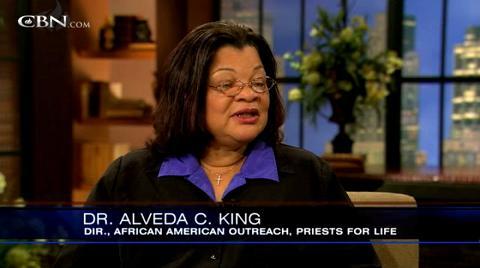
MLK’s niece, Alveda King, discusses stories told by black and brown Americans, and their contributions in their search for the American Dream.
Read Transcript
- Like bandages on woundsthat still need healing.
That's how Alveda King describes
some of the solutions tothe deep, divisive issues
that are crippling our country today.
So what is the answer?
Take a look.
- [Andrew] Alveda King, nieceof Dr. Martin Luther King Jr.,
believes in pairing socialjustice with righteousness
when confronting theissues plaguing our nation.
At a time when the country is divided
over race relations,abortion, religious freedom,
and political correctness,
Alveda joins other prominent voices
to address these hot button issues.
In her book, "Black and Brown Americans
"in Search of the American Dream,"
over 30 leaders contribute
by not only raising important questions,
but also bringing strategic solutions
for healing andrestoration in our country.
- Welcome back to The 700 Club
our good friend, Alveda King.
It's so wonderful to have you back.
- Hello, Terry, it's so good to join you.
- We get to cook together
- We do.- on certain occasions,
but today, you have new booksout, a pictorial history
as well as the bookthat was just mentioned.
Talk a little bit about the current issues
that divide our country today.
What's your take on all of this?
- I was listening to Pat a little earlier
some of the things thatare concerning folks,
and I do want to mention Chick-fil-A
and their decision not to,of course, continue to donate
to certain companies,but that doesn't mean
that they're not still engaged,
that they don't still care about America.
They definitely do.
So sometimes people willchoose different paths,
but the best path we canchoose is agape love,
Christian love, and to extend love
in the midst of the heat.
People were upset aboutthe Kurds, for example,
and decisions that the president made
and he had to move in acertain direction to do that.
But if we can just stopcriticizing each other,
arguing with each other.
And you've heard mesay, every time we talk,
it's always around Christmasand Thanksgiving time,
"Don't take the turkey legoff and hit people with it."
(Terry laughs)Hold their hand
and pray for them.- Yes.
- Pray.
- One of the things in your book,
"Black and Brown Americans inSearch of the American Dream,"
you share so much of thehistory of what has happened.
It seems to me like one of theissues in our country today
is we don't know our own history.
- This is true.- How important is that
to finding healing, whetherit's for us as Americans,
as a country, or for theblack and brown community?
- I named it black and brown community
and had about 28 of my friends,
a couple of us did two articles,
so there are 30 articles together
from every ethnic group, every age group,
every socioeconomic group,but talking about issues
that impact the AfricanAmerican community.
But we didn't want toleave out any community
because we are one blood.
- Yeah.- We are one human race.
And we have to address eachother as brothers and sisters,
and we've not been able to dothat in America completely.
The message will come.
My uncle, Martin LutherKing Jr. delivered it well
during his lifetime.
But you have to tell the sametruth in every generation.
- [Terry] Who are some of the leaders
that contributed to this book?
Because you have, asyou mentioned, so many.
- Yes.
Well, and it's a diverse group.
Our friend, Bishop HarryJackson, for example,
a very strong leader inthe Christian community,
a pastor and a minister.
Nina May, who is a filmmaker,
and she deals with the issue though
of restitution and restoration
and whether we should have reparations.
And Nina says, well, thepeople who did the harm
need to pay the reparations,not America's taxpayers.
That's just an example.
But each one, ReverendBill Owens for example,
Ryan Bomberger, who's an advocate
for life and adoption.- Love Ryan.
- [Alveda] It's just adiverse group of people.
- You just mentioned reparations.
What are your thoughts on that?
I mean, that's an issue
that I think some people can't relate to,
some people feel strongly about.
It's another divisive thing today.
- With reparations, it's notgonna be done only with money.
Of course, some monies andsome funds could be used,
but it needs to be creative.
I remember, President Obamaand President Trump both said
that they did not see thetaxpayers paying for it.
They had differentreasons for saying that.
However, the people who reallyneed to pay the reparations
are the ones who are still profiting
off of money that was made from slavery,
from abortion, and all of that.
You've got billion dollar corporations
who are still very wealthy today,
and they built their wealthon that type of pain,
slavery, segregation, and abortion.
And so they should be the ones
that need to come up withsomething creative and pay.
- You mentioned Ryan Bomberger,
and you yourself aresuch a strong proponent
of the pro-life moment.
Do you think we're gaining ground at all?
- Blessedly, we can see, in America,
that the pro-life message is growing.
More Americans believe that it's important
to protect the sanctity of life.
Now we had some surprisinghelp from New York and Virginia
when two governors said it wasokay for a baby to be born,
and if the intention wasto abort, let the baby die.
America went into shock.
And so many people who wouldn't touch it
have now said, "No, we needto take another look at that."
So we are moving forward.
- With your new book,
what do you want thetakeaway to be for people?
You've got an amazing pictorial history
that goes with it as well, buttalk about the book itself.
- The book, if we can inform and educate
and activate communities to not argue
about the elephant in theroom, which is skin color.
Acts 17:26: Of one blood, God made us all.
We are brothers and sisters.
So we can educate and informourselves if we read that book
and look at the variousperspectives on the subject.
And of course, the pictorial history
of the pro-life movement,15 years of pictures.
And so these are thingsthat maybe can just help
to inform us if we take a look.
- You have to take the look
- Yeah.- before you can
understand all that's going on.
Thank you so much.
You leave a legacy of great work.
You're always, and a legacy of family
and a legacy of life.- Thank you.
- It's great work that we see you doing
- And we're celebrating- and we thank you.
- Christmas, Gigi to Gigi,- Gigi to Gigi.
- in our green- We're in the kitchen.
- and our burgundy and cranberry
and our necklaces are similar.- That's right.
- We always get the same memo.
- That's right.
Share recipes here.
Well the book is called"Black and Brown Americans
"in Search of the American Dream,"
and Alveda King also has another book.
She just mentioned it.
It's "A Pictorial History
"of the National Black Pro-Life Movement."
And both books are available nationwide
and a wonderful placeto begin to understand
and to look back and have it matter
or the decisions and the choices
we make today.- Thank you.
- Thank you.
It's always great to have you here.