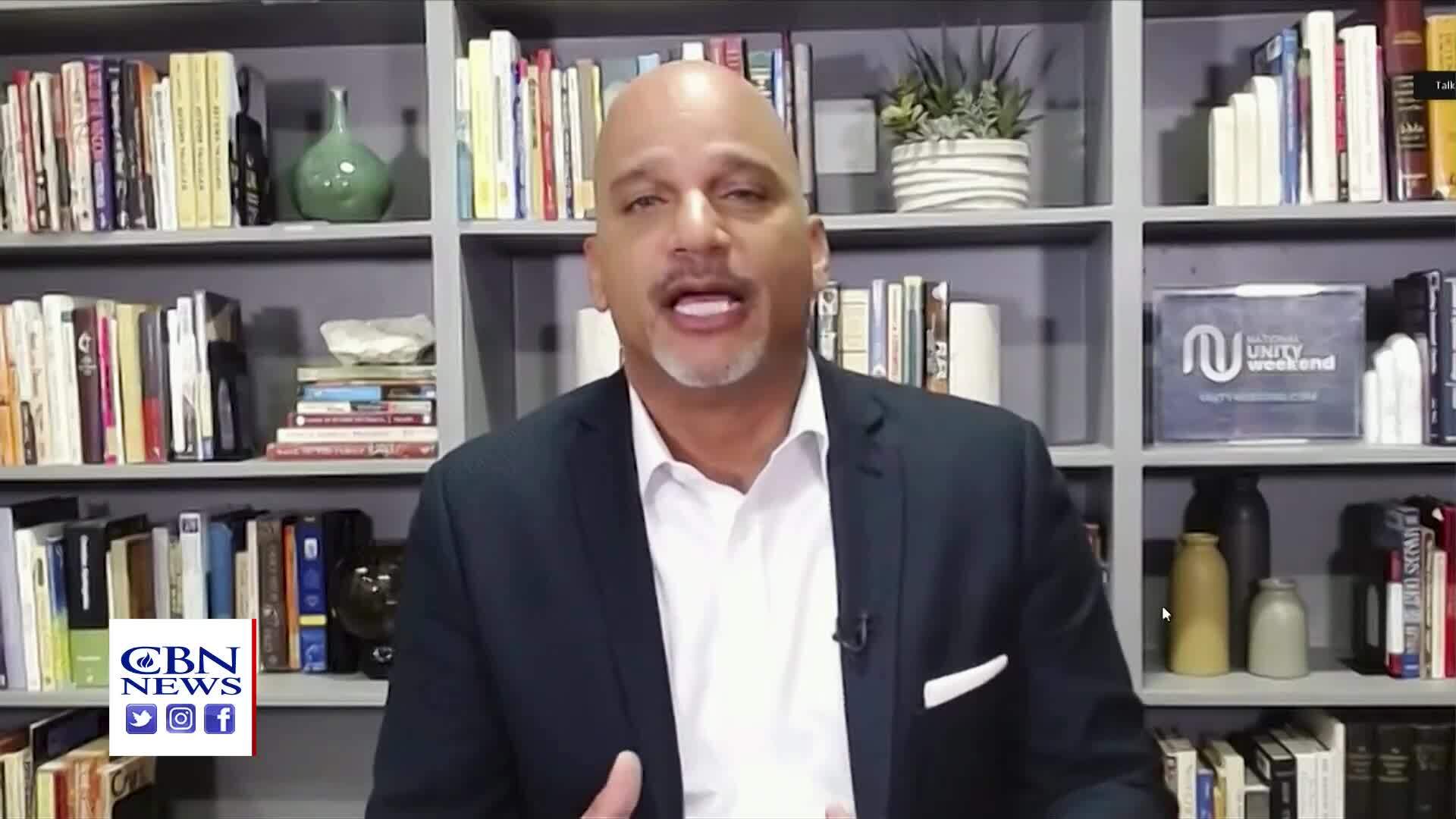
Author David Ireland discusses racial and cultural disharmony and how the church is called to demonstrate unity.
Read Transcript
- Well 30 years ago, David Ireland
experienced a definingmoment at a grocery store.
He noticed the diversityof all the shoppers
and then he heard the voice of God.
Today he's the pastor ofa multiracial congregation
with over 40 nationalities.
Take a look.
- [Narrator] David Ireland isthe pastor of Christ Church,
a culturally diversecongregation of 9,000 members
in northern New Jersey.
When he was 10 years old,his home was fire bombed.
- Our family was one ofthe first Black families
to move into this sectionof Queens, New York,
called Rosedale, andfor the next six months
we had round the clock surveillance
because of the deaththreats that followed.
- [Narrator] In his book "One in Christ",
David shares how God healedhim from the wounds of racism,
and he gives practical tips on having
healthy cross-cultural relationships.
- Please welcome back toThe 700 Club, David Ireland.
David, great to have you back on the show.
- My pleasure, Wendy.
Thanks for the opportunity.
- Well tell us what happenedto you and your family
when you were just 10 yearsold and how it affected you.
- My family had migrated from Jamaica,
and I came a couple of years after that.
At age 10, when we moved into this home
in Rosedale, Queens, NewYork, within two weeks
of us living there, thehouse was fire bombed.
I was actually in the rear bedroom window
and I saw this explosion takeplace as it hit the window.
It was a Molotov cocktail.
- [Wendy] Was anybody hurt?
- No one was hurt.
The five White teenage boysthrew this Molotov cocktail
at the window, it destroyed the house,
but we had to have round theclock police surveillance
for at least six months, 24 hours a day.
- [Wendy] What year was this, David?
- This was back in the late,the early '70s, I should say.
The early '70s, and sothe boys were caught
and nothing happened to them.
The police department saidit was just a childish prank.
It was a different era back then.
- But you were 10.
How did that affect you?
- I had no concept of racism.
I came from the island nation of Jamaica.
I didn't know what racemeant, I had no idea,
and on top of that, I was 10 years old,
so I had not had any formation about
the difference betweenWhite, Black, Latino, Asian.
I had no concept whatsoever.
But my parents were very protective of us
to not form any kind of racistmindset and perspective.
So they hid from us all the letters
that they would get afterwards, hate mail,
saying we would have killedyou, those kinds of things.
- [Wendy] Oh my.
- In fact we had an aboveground pool in the backyard
and, you know, the yearafter we got the house
my parents took out the pool.
I'm wondering why they took it out
and they planted a flower garden there.
It was not until I was anadult that my mother said to me
the reason why we took out the pool
was because we were afraidthat neighbors would pour
acid in the water tocreate harm and danger,
so we took it out for that reason.
So they shielded us a lot,but the defining moment for me
was when I came to faithin Christ at age 20, Wendy.
- [Wendy] You were in a grocery store.
- That was a little bit afterwards,
but when I came to faith inChrist, my heart was changed.
But when I planted ChristChurch, I was 24 years old,
my wife was expecting our first child,
married two years at the time,
and she asked me to go to the store
to buy some items for her.
I don't recall what thoseitems were, but I do know-
- [Wendy] Pickles and ice cream (laughs).
- (laughs) Those kinds ofthings, odd combinations of food.
I took one of thoselittle red hand baskets
and I was walking down the aisle.
I got to one aisle, putmy hand on the item,
put it in the basket,and I happened to look up
at the end of the corridor, and I saw,
it was a very stark reality,Whites, Blacks, Asians,
you know, Latino, I saw biracial people,
and for the first time in my life,
I heard the audible voice of God.
Now our church was only two weeks old.
I had no vision for the church.
I didn't even know I needed a vision.
I couldn't even spellchurch, I was 24 years old,
and so the Lord said tome in that grocery store,
"David, why can't it belike that in my house?"
- [Wendy] Oh my.
- And I started weeping uncontrollably,
and I'm not a weeper.
- [Wendy] In the grocery store.
- In the grocery store.
A lot of things were odd.
The first thing that was odd is that
Jamaica was colonized by British,
so my culture is very British,
so I don't show my emotions publicly.
The second thing, you know,my science background.
If you ever watch "StarTrek", I'm the Vulcan.
I'm the guy, just giveme the facts (laughs).
So here I am weeping uncontrollably.
It was messy, because what God did for me
in that grocery store, he placed on me
something that was troublesometo him about his church.
Why is it that Blacks andWhites and Asians and Hispanics
worship separately at thesame time, the Sunday Morning?
Martin Luther King Junior said 11:00 a.m.
on Sunday mornings is themost racist hour in America.
- [Wendy] Heaven's notgoing to be like that.
- It's not, and so I weptbecause God placed on me
something that the wanted me to do.
- Well, Pastor, youare now the pastor of a
9,000 member congregationin northern New Jersey.
- Correct.
- And very racially--
- [David] Yeah, we have about70 different nationalities
that's a part of our church.
- [Wendy] Yet most churchesin America remain segregated.
- [David] Yes.
- [Wendy] Why?
- Well, I mean only 3%of churches in America
represent a diverse congregation,
diverse meaning at least11% of the congregation
is of a different racialmakeup than the majority.
- How can we change it?
- We can change it several ways.
It starts on a personal level.
It can't be a corporatelevel, it's personal.
If racism is a problem to someone,
that means reconciliation must become
a solution to that person.
The idea is that wehave to then look at it
in a personal, introspective way,
and so I talk about coaching people.
In fact, I was a cross-cultural coach
with the National Basketball Association
because basketball becamean international sport
and so people are coming fromdifferent parts of the world
to America in order to playbasketball professionally,
and so my job was to help players,
through the rookies' transition program,
help players learn to getalong with one another.
And it starts off again personally,
personally meaning that if I'm going to be
racially attractive, I must make someone
who's of a different racefeel comfortable with me
and in my presence becauseI'm comfortable with me.
If I'm comfortable myself,
I'm going to then be able to project that
comfort on the other person,
and so it's going to createthis sense of openness
and this sense of support and trust
when I'm in that person's presence.
- Well in your book you write about
the two main building blocks in bringing
different people together.
What are those blocks?
- I look at the idea ofhaving the right attitudes
and also the right actions,because when I went through
in my dissertation on theBlack/White relationship
in large multiracial churches in America,
I'm going across the country,
reading every book on this topic,
and adding to it, I foundout that the churches
that are cross-racial, thatare multiracial in composition,
you know, when I did focus group studies,
there were clearlyreasons why relationships
that were healthy cross-racially
is when they had rightattitudes and right actions.
Right attitudes represents things like
do I make you feel comfortable with me?
Do I make you feel comfortablewith you when you're with me?
- [Wendy] Yes, you do.
- And those are goodquestions that we have to ask.
Can I share my myths with you?
Everyone has myths,myths about other races,
myths about people, mythsabout ethnic groups,
and when a person feelscomfortable with you,
they can share their mythswithout the fear of rejection,
because even if theysay something foolish,
you'll say, oh, that's silly.
Let me tell you what you ought to do
if you're going to create ahealthy cross-race relationship.
- Well, Pastor David, we havejust scratched the surface.
There's so much in here.
His book is called "One in Christ"
and it's about bridgingracial and cultural divides.
It's so important.
It's available wherever books are sold.
You can hear more fromDavid on our Facebook page.
Just go to Facebook.com/700club.
David, thanks for coming back
and sharing this amazingtestimony with us.
- Oh, my pleasure, my pleasure, thank you.