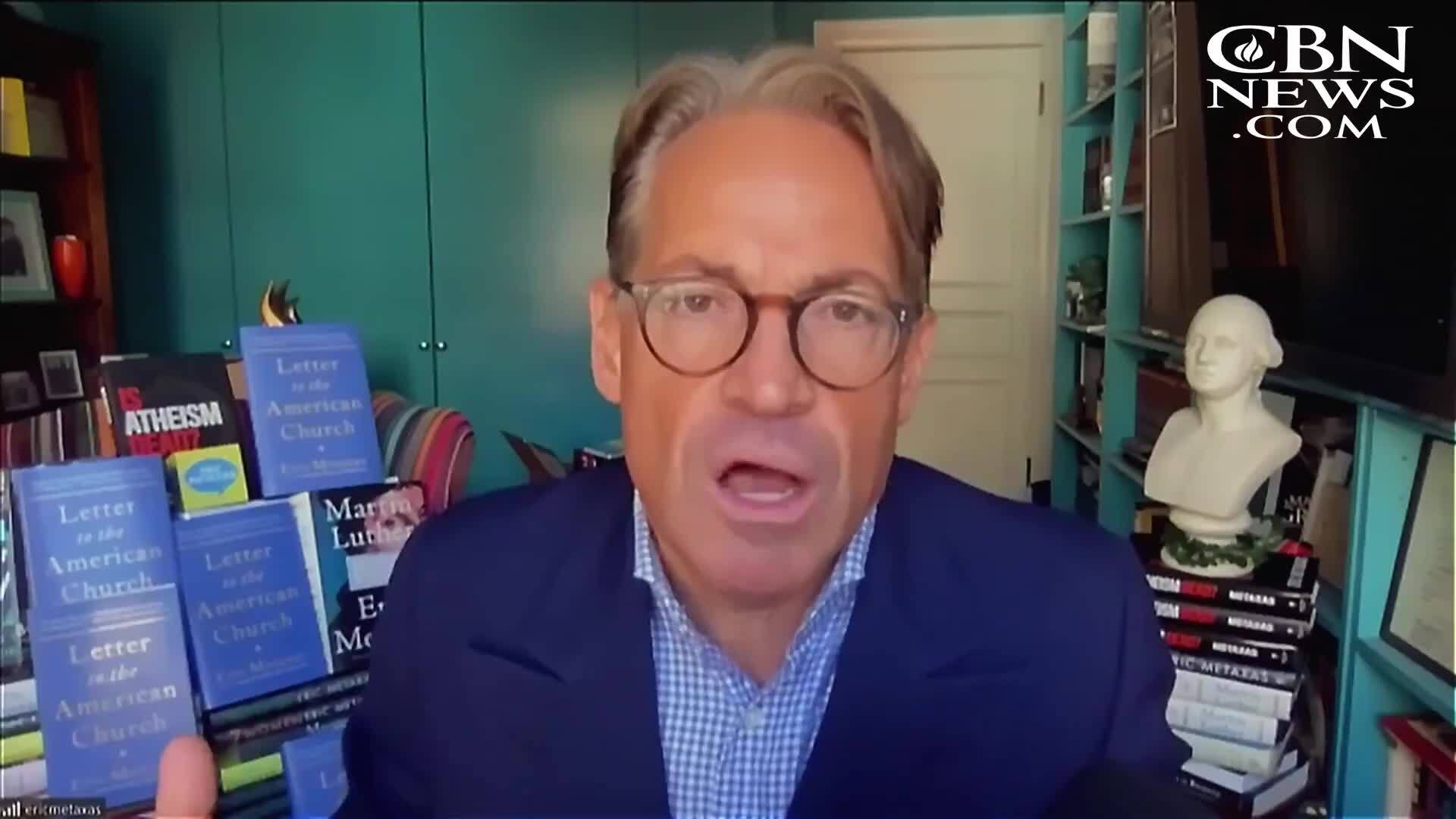
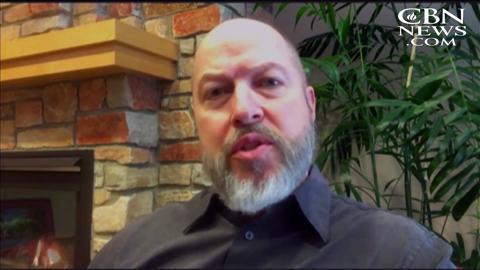
Eric Metaxas is an
author and radio host.
His latest book is about Martin
Luther and the Reformation.
We're going to talk about
the book in just a bit.
But first, there's
some events in the news
we want to ask you about you
join us here now to talk about.
Let's begin with the
Las Vegas shooting.
It's the worst shooting
in American history.
These events cause
us as Americans
to question ourselves
as a nation.
What kind of questions do you
think we should be asking?
Well, I don't
know that it would
make me think about questioning
ourselves as a nation.
I think it makes me think.
I think it makes
most people think
of the ultimate questions.
What kind of a
world do we live in?
What kind of a God is out there?
If there is any God, what kind
of a God would allow this?
Why would He allow this?
What are we supposed to think?
And I think the short
answer is, we don't know.
This is a challenge to
people of faith like me.
Now it's kind of funny,
because you think, well,
why should we be
challenged by this?
There's this thing
called the Holocaust.
I mean, do we only pay
attention to what's
happening in the news?
Shame on us.
We ought to understand
that there's
brokenness and pain and evil
in the world every single day
since Adam and Eve
sinned in Eden.
I think we need to
understand that,
that this is the reality
in which we live.
It makes me say, this
is why we need God.
This is why we need to know that
God is with us in suffering.
He's not some Greek
god up in the clouds,
capriciously dealing with us.
He loves us.
We live in a broken world.
By sending Jesus, He's bringing
healing and reconciliation,
but we're not there yet.
It happens to each
of us individually.
So it's something that
forces us to think
about the big questions.
At least, we ought
to be thinking
about the big questions.
Absolutely.
We know that you've written
about the link between virtue
and freedom.
How can events like this
lead to a loss of freedom?
Well, I think that the
typical thing that will happen,
whenever something terrible
happens, people tend to say,
hey, how can we fix it?
I know how we can fix it.
Let's have more laws, more laws.
Now if you really
understand American freedom,
if you understand
freedom, you know
that the more laws you
have, the worse you're off.
In other words, self
government means
we govern ourselves
to the extent
that we don't need
too many laws.
If you think you can
fix things with laws,
it's like trying to fix
human nature with technology.
That's foolish.
Human beings are who they are.
I think that the standard
thing is to figure out a way,
and it's always
politics, to say we're
going to do this and
this and this and this
and that's going to fix it.
It doesn't mean that
we can't do something,
but we should err on
the side of caution,
err on the side of fewer laws.
Because there is
always a temptation
to give up a little
freedom for more safety.
Every time you do that,
you don't get that back.
How do we go about restoring
increasing virtue you think?
Well, you've asked the right
question, Ephram, thank you.
Because that's
what I write about.
I wrote about in
my previous book
about America, if
you can keep it,
if we don't understand that
at the heart of freedom
is this idea of virtue which
all of the founders understood
and all of the
founders understood
the link between virtue
and faith and freedom.
If we do not
understand that it's
going to be a vibrant church
that restores freedom and that
makes America great again
or it will never happen.
Period, end of sentence.
So the church needs
to be the church.
The church needs to
stop being timid.
We need to know what
we believe and live it
in faith, in boldness, in love.
That's the only way you
get freedom in this world.
So I say that as a challenge.
Because if we don't do
it, it will not happen.
Indeed.
And speaking of
challenges, we've
seen a rough few weeks
from hurricanes, to floods,
to mass shootings.
But yet we continue to see
the bravery, the generosity
of Americans stepping up.
You said that's part of
American exceptionalism.
How so?
Oh, absolutely.
In other words,
people think, first
of all, when we say
American exceptionalism,
it doesn't mean that you or I
are better than anybody else.
We're as sinful as anybody else.
But the ideas behind America,
which you didn't come up with
and I didn't come up with, so
we can't take any credit, right?
But we have been bequeathed
these ideas from the founders
and where they get them from.
They got them, ultimately,
from Martin Luther
and from the scripture
and from God.
But these ideas never
existed in history
until the United
States of America
brought them into being
in a way that people
say people can live like this.
Those ideas have spread
around the world.
There are countries
all around the world
that have little bits
and pieces of this.
That's the only reason
we're exceptional.
So let's not lose
sight of the fact
that we can't beat
our chest with pride.
But at the same time,
we should be proud.
Because we've been
given the honor
of representing these principles
and these ideas in the world.
I really think that
that's the only way
you have a healthy culture.
So that when tragedy
like this happens,
you see people
doing good things.
Trust me when I tell you,
there are parts of Africa today
that are torn by--
you're not seeing
this kind of stuff.
You're not seeing this kind
of stuff in India or whatever.
This is because we
have been steeped
as a culture in the idea
of loving your neighbor,
even if you're not a Christian.
These ideas have become
part of our culture.
We need to understand,
first of all,
where they came from and
then to say that, by the way,
these ideas are intended
for the whole world,
not just for America.
Real quick, before we get
to your book on Martin Luther.
You called on Christians to vote
for President Trump in 2016.
How do you think he's
doing as president in light
of all the events we've faced?
You know what his biggest
accomplishment so far has been
is not being Hillary Clinton.
How's he doing
there, 100% percent.
I never said that I
thought like Trump
was a saint or a
Reagan or something.
But I thought to
be perfectly blunt,
and I said this over
and over, I thought
that Hillary Clinton represented
such a threat to freedom
that I said, we need
to take that seriously.
When people said, well,
I'm not going to vote,
because I don't like
this about Trump.
He said this.
Look folks, if you don't
vote and she gets elected,
you're on the hook.
I really feared that somebody to
continue the policies of Barack
Obama, the worst
of those policies,
it would be the end of America.
We're on the edge of
the table right now,
and I think that this was
an opportunity to pull back.
So how's he doing?
I would say he's doing fine.
Now your book
is Martin Luther--
The Man Who Rediscovered
God and Changed the World.
How is the Reformation
still affecting us today?
Oh, my gosh.
The fact that we are standing
here having this conversation
is a direct result
of the Reformation.
Now again, I didn't know this.
I go into writing most of
my books pretty ignorant.
My friend Greg
Thornberry twisted my arm
into writing this book.
He said you wrote Bonhoeffer.
It's the 500th anniversary
of the Reformation.
You need to write a
biography of Martin Luther.
There isn't a book
like this out there.
You've got to write it.
Finally, he persuaded me that
Luther was so influential.
Again, as usual I'm embarrassed
that I didn't know this,
but every freedom
we take for granted.
Some of the ones we just touched
on in America, self-government,
the idea that the individual
has a voice, that the individual
can speak against the state.
That the state should back up
when an individual who is free
says something.
Those ideas were
not in existence
when Martin Luther was born.
In 1517, 500 years
ago this month,
he did something that
launched all of these ideas
into history.
The ramifications
have been nonstop.
What I say is that
everything that he did,
and I think those who read
the book will understand this
very clearly, that what he did
opened the door to the future.
For 500 years, we've been
living in the world created
by the door that he opened.
It was by God's grace.
He didn't do it intentionally.
He was one of these
humble men of God
that said I'm just going to
do what God calls me to do.
And out of that came everything
that we take for granted,
the modern world, what we call
tolerance, pluralism, freedom,
religious freedom.
All of these things that
we kind of take for granted
did not exist before he took
his stand 500 years ago.
So at least knowing our
history is a good reason for me
to write the book.
Absolutely.
If you wanted people to know
one thing about Martin Luther,
what would it be?
He was a chain smoker.
That's not true.
Luther is such a
colorful character.
I joked around a
number of times.
I said he makes Donald
Trump look like Mike Pence.
Basically, he was so outspoken
and colorful and brash
that his best friends
were bothered by it.
They kept telling
him stop tweeting.
Except 500 years ago, they
would say stop saying this
and stop doing that, whatever.
But he's a colorful figure.
There's a big upside and
there's a big downside.
So I think that all of that
is my way of saying that he's
a very entertaining figure.
I wanted to write a book
that was fun to write.
This was actually a
lot of fun to write.
First time I think I've ever
written a book that was fun.
But his story is
not just important,
but it is very entertaining.
Because he was such a
passionate, intense, colorful
character.
Beautiful.
Well, the book is
called Martin Luther--
The Man Who Rediscovered
God and Changed the World.
Thank you so much for the book,
and thank you for your time.
Thank you.
Much appreciated.